Weihnachtskrippe is the name given to a Nativity scene in Germany, often found in town centres during advent. It depicts the birth of Jesus in Bethlehem.
Many families have their own model Weihnachtskrippe at home. Some of these are self-made, others have been collected over a period of time with a new figure being added each year. Typically, these are also passed down through the generations.
Surprisingly, they were banned in churches at the end of the 18th Century.
To hear a simple explanation and a short discussion in German, listen to the podcast:
(Press the “play” button to listen to the podcast)
In this edition of German Words Explained we take a look at three traditions associated with New Year’s Eve.
Raclette is originally a traditional Swiss dish made from cheese. A large piece of cheese is put near a fire and is brought to melting point. When the cheese is soft and about to melt, a layer is scraped of and eaten with bread.
The modern raclette is an electrical table-top heater. Small dishes are filled with chopped-up vegetables, eggs, sausage rings and other small pieces of food and then covered with cheese. These are then placed under the element of the raclette. Many raclettes have a metal top where meat or bread can be fried, some even have stone tops for cooking steak.
Foundue is probably the most well-known outside of Germany, also being a traditional Swiss dish. Originally made by melting cheese and often wine over a flame, many people in Germany use the same form to heat cooking oil on New Year’s Eve and cook small pieces of meat in it. Others melt chocolate instead and dip pieces of fruit in it.
Bleigießen is definitely not to eat, it is a tradition that families carry out on New Year’s Eve. They buy small packets of lead – often together with a special spoon. The lead cubes are placed on the spoon and held over a candle so that they melt. Once the lead is molten, it is dropped into cold water where it sets into a new form. The trick is then to decipher what the form means for each person for the coming year.
To hear a simple explanation and a short discussion in German, listen to the podcast:
(Press the “play” button to listen to the podcast)
The Christkind is a figure in Germany that brings presents to the children on Christmas Eve, especially in southern parts of the country.
Until the reformation in the 16th century people in Germany did not give each other presents at Christmas, instead the children received their presents from St.Nicholas (Nikolaus) on 6th December. Martin Luther, however, opposed the catholic saints and apparently introduced the idea of giving presents on 24th December. These were brought by the Christkind, who is often depicted in white and similar to an angel.
It is said that it comes in through the window and leaves presents around the Christmas tree while the children are out of the room.
Even though the Weihnachtsmann is ever more present, especially in the media, people still ask children “what did the Christkind bring you?”
To hear a simple explanation and a short discussion in German, listen to the podcast:
(Press the “play” button to listen to the podcast)
Spekulatius is a type of spiced biscuit that is eaten at Christmas in Germany. As well as the normal form of the biscuit, there are variations made with almonds or with extra butter. The form of the biscuits tells the story of St. Nicholas.
Because of the price of the spices involved, these biscuits were expensive to make until the 1950s, so they are considered to be somewhat exotic. These days, however, they are readily available in most supermarkets.
To hear a simple explanation and a short discussion in German, listen to the podcast:
(Press the “play” button to listen to the podcast)
You are currently browsing the archives for the Christmas category.
Please click on ACCEPT to give us permission to set cookies [more information]
This website uses cookies to give you the best browsing experience possible. Cookies are small text files that are stored by the web browser on your computer. Most of the cookies that we use are so-called “Session cookies”. These are automatically deleted after your visit. The cookies do not damage your computer system or contain viruses. Please read our privacy information page for more details or to revoke permission.


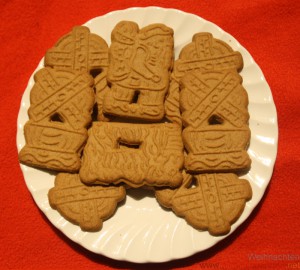 Spekulatius is a type of spiced biscuit that is eaten at Christmas in Germany. As well as the normal form of the biscuit, there are variations made with almonds or with extra butter. The form of the biscuits tells the story of St. Nicholas.

